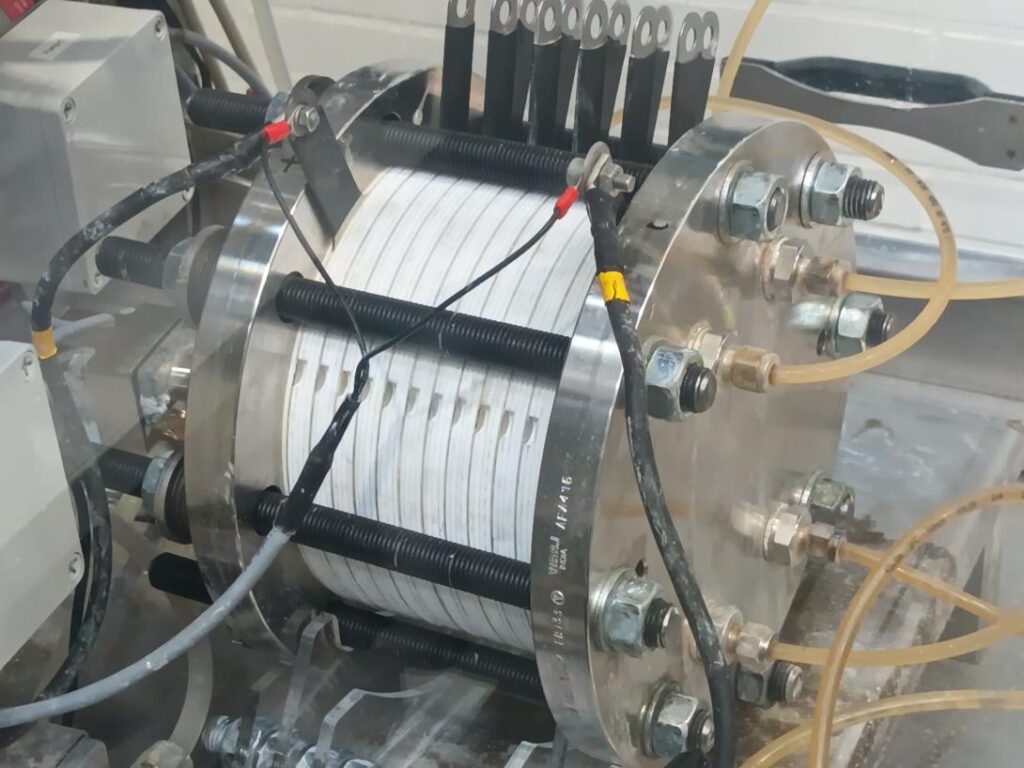
Green hydrogen has become a key element in the transformation of the energy system. It is expected to play an important role particularly in reducing industrial emissions as well as in storing and further utilizing renewable energy. However, hydrogen does not produce itself—it requires functional and cost-efficient technology. One of the most important key technologies is the electrolyser, which splits water into hydrogen and oxygen using renewable electricity.
At LUT University, the project Green Hydrogen Production – From Research to Cell Manufacturing Expertise was carried out in 2024–2025. The aim was to develop design and construction expertise for alkaline electrolyser stacks and to strengthen the prerequisites for industrial utilization of electrolyser technology. The project focused especially on how research-based knowledge can be transferred into practical and scalable solutions.
Manufacturing Expertise Plays a Crucial Role in Green Hydrogen Production
In discussions about green hydrogen production, attention is often focused on renewable electricity and its availability. However, an equally important question is what kind of technology is used to produce hydrogen and how cost-efficiently this technology can be manufactured at an industrial scale. The demand for electrolysers is expected to grow rapidly, placing pressure on both device performance and manufacturability.
The electrolyser stack is the core component of the system where hydrogen production actually takes place. Structural solutions within the stack affect, among other things, the efficiency, tightness, lifetime, and cost of the system. At the same time, the structure largely determines how easily and efficiently the system can be manufactured and assembled in an industrial environment.
Stack Development and Project Results
During the project, the structure and operation of an alkaline electrolyser stack were developed and analysed by combining research data, experimental work, and prototype construction. The work focused particularly on the stack’s electrochemical operation, phenomena related to liquid and gas flows, and structural solutions that impact performance, reliability, and manufacturability.
A key objective was to identify structural solutions that would allow the stack to be not only functionally efficient but also manufacturable and assemblable at an industrial scale. Supporting this goal, the project developed stack structures that improve manufacturability and ease of assembly. In addition, the suitability of these solutions for larger system configurations was evaluated.
During the project, a kilowatt-scale alkaline electrolyser stack prototype was built and tested. Testing enabled practical evaluation of the developed structural solutions. The prototype testing demonstrated the feasibility of the solutions at laboratory scale and highlighted key simplification needs relevant to scalability and practical implementation.
As a result, the project produced a comprehensive understanding of the functional, structural, and manufacturability-related requirements of alkaline electrolyser stacks. Advanced analysis and calculation methods support the evaluation of electrochemical performance and help identify structural solutions that can improve both performance and manufacturability.
From Research to Practical Solutions
The project concretely advanced the transfer of design and construction expertise for alkaline electrolyser stacks from the research environment toward industrial applications. It also strengthens South Karelia’s position as a development environment for the green transition and energy technology, where research, practical development work, and future industrial applications converge.
While the project established a strong scientific foundation for understanding stack structures, further steps are still needed on the path from the laboratory to industrial production. As a natural continuation of this work, a new development project, Industrial Manufacturing of Alkaline Electrolysers, was launched in April 2026.
Whereas the completed project focused on electrochemical operation and experimental prototype testing, the new project shifts the focus toward manufacturability and industrial implementation. The goal is to support the transition from complex and labor-intensive device manufacturing to efficient industrial production.
The final report and additional information for the Green Hydrogen Production – From Research to Cell Manufacturing Expertise project will be published during spring 2026 on LUT University’s project page:
👉 https://www.lut.fi/en/projects/green-hydrogen-production-research-stack-manufacturing-know-how