
10.3.2026
Lappeenranta electrifies transportation on land, at work sites and in the air

Lappeenranta is ambitious in its climate targets, and green electrification is a common objective for the entire region. The city, LUT University and companies are working hard to test and develop not only the electrification of heavy-duty road transport and large machinery, but also electric aviation. In fact, a test field for electric aviation is emerging on the side of the LUT Electric Mobility Research Center (EMRC).
First, the facts: 15% of the world’s climate emissions are caused by rubber wheels spinning by burning dinosaurs, or oil. This is how Ville Naumanen, Research Director at the EMRC, puts it. In other words, fossil-fuelled heavy vehicles and transport in general are a significant source of carbon dioxide emissions. While transport emissions account for more than one fifth of all CO2 emissions, road transport accounts for as much as 74 per cent of them.
The problem is therefore enormous. Fortunately, new solutions are constantly being developed under the leadership of Naumanen and partners. Electric cars are already becoming commonplace in passenger traffic, but the change in heavy vehicles has been slow. At LUT, electrification has been studied for a long time, and the aim is to use electricity to speed up even the heavier rubber wheels. At the same time, attempts are made to identify the bottlenecks and challenges still associated with electrification.
– If we hop on an electron in a green power plant, for example from a household solar panel in Lappeenranta, it first travels through the electricity grid and the large infrastructure before reaching an electric car charger. From there, it jumps into the battery and ultimately makes the wheels run because we people need something, summarises Naumanen.
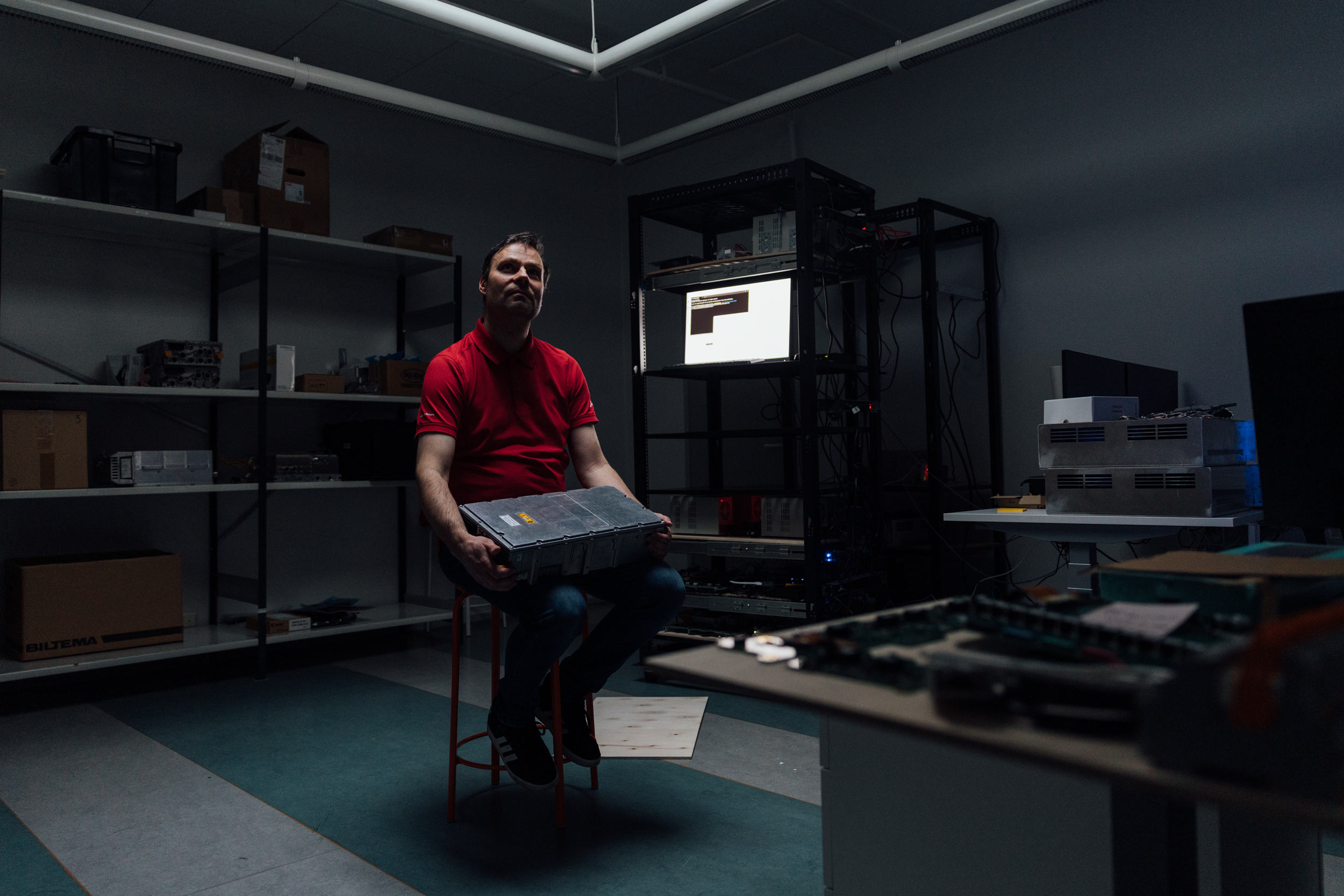
Naumanen has a dual role in promoting electrification. In addition to the Electric Mobility Research Center, Naumanen works as research director at Kempower, which manufactures charging devices for electric cars. The company opened an office on the university campus, in September 2025. The reason for arriving in Lappeenranta was specifically LUT and its electric atmosphere.
– We have the most in-depth cooperation between the academy and industry, and it is realised in our research centre in the middle of the university campus. This wouldn't have been possible with any other university. I act as a conductor in both directions and stand on both sides of the fence, so to speak. The teams from both the university and Kempower deepen the cooperation, explains Naumanen about the symbiosis.
"You can fetch wood from the forest with an electric vehicle"
According to statistics, the number of electric heavy-duty vehicles in Finland has doubled in recent years. Despite this, there are only an estimated 160 fully electric lorries. The Norwegians are dominating the shift to electric transport in Europe. Germany, France and Great Britain have also got off to a good start. According to Naumanen, Finland is lagging far behind.
– There has been a debate on whether you should first have the electricity or electric vehicles. Now, we are investing in the charger network and enabling the electrification of transport also this way. The EU strongly supports it, explains Naumanen.
On the Finnish scale, the border line seems to run along main road four: in the west, the charging infrastructure has developed well, while there has been a black hole in the east, which has now partly been filled.
– You can fetch wood from the forest with an electric vehicle. It would therefore be essential to make large heavy transport users, such as paper mills, steel mills and others, see the benefits of electric transport.
In the long run, electric lorries are already cheaper than conventional ones
Lappeenranta has outlined its goal to be a model city for environmentally friendly practices. Efforts to achieve this goal have been made and are continuously made also outside LUT.
For example, Lappeenranta has already been WWF’s climate capital twice in the past decade. It is also the first city in Finland to purchase only electric and biogas cars. The EU has also given recognition in the form of the Green Leaf 2021 award and by selecting Lappeenranta as an EU Climate City.
The next major objective is to be carbon neutral by 2030. In 2050, Lappeenranta intends to be a zero-emission city that does not overconsume or produce any landfill waste.
The city also strongly supports companies that promote electrification. One company developing electric motors for heavy vehicles and machinery and the electrical converters that control them is Danfoss Editron, for which the city is currently building new larger premises. The premises are due to be completed in 2026. Danfoss Editron currently employs nearly two hundred people in Lappeenranta. The new premises will enable growth.
– Lappeenranta and LUT are also very important to Danfoss. We have well-functioning facilities, skilled labour available and research cooperation, says Tommi Kankaanranta, Technology Manager at Danfoss Editron.
Danfoss Editron is developing new technology for electric motors. This also requires new types of inverters and converters, i.e. various kinds of electrical power conversion systems, which are being developed in Lappeenranta.
– Converters improve vehicle usability and performance. A conventional internal combustion engine (ICE) vehicle responds with a slight delay. With electricity, the effect is immediate. In other words, the same amount of energy allows for a longer driving range and, at the same time, emissions will decrease, explains Kankaanranta.
The electrification of heavy vehicles is slowed down by the high price of the vehicles, which is still significantly higher than that of diesel-powered vehicles. However, this is not the case in the long term.
– An electric car is considerably more maintenance-free than a conventional internal combustion engine vehicle. The vehicle does not wear mechanically in the same way as an ICE vehicle. It has also been shown that the efficiency difference and current diesel prices already make an electric lorry cheaper than conventional ones, during its life cycle.
Lappeenranta is also electrifying aviation
Lappeenranta has the oldest operating airport in Finland, but change is in the air even there. The aim of the LUT Electric Mobility Research Center (EMRC) is to recruit more and more top experts in aviation and turn the Lappeenranta Airport into a multidisciplinary research airport. LUT is exploring different energy sources for aviation, including electricity, biofuels and hydrogen-based energy as alternatives to kerosene.
Among other things, the university is studying the possibilities of developing a high-speed electric motor suitable for electric aircraft. The future Danfoss Editron plant is also located near the airport, which enables testing, development and electrification of the airport ground support equipment.
– The Lappeenranta Airport is literally located in the middle of the city and in the backyard of the university campus. Land areas that can be taken into use for solar energy and electricity production have already been mapped. This means that we can start building energy sources for future aviation needs, explains Ville Naumanen from EMRC.
From the eastern border to Turku in an hour with electric power?
According to Naumanen, short flights with electric aircraft are already being made. For example, in the summer of 2025, a four-seater fully electric aircraft started operating in Norway, and it is being charged with a Kempower charger. The Norwegians are ahead of others in the development, as the mountainous terrain makes road traffic challenging.
In Finland, too, transport across the country, i.e. journeys of 200 to 500 kilometres, would be attractive alternatives for electric aircraft. For longer journeys, electricity is a challenging energy source.
– Without a doubt, it would be great if you could get to Vaasa or Turku from the eastern border in an hour instead of seven. Or if electric aircraft could fly to Helsinki-Vantaa Airport from smaller regional airports.
The electrification of aviation requires, above all, a functional infrastructure. Having just one airport suitable for electric aviation is not enough.
– We already have a pretty good aviation ecosystem, which we now want to enhance. In other words, we are not only talking about electric aircraft, but also the other infrastructure with which electricity is produced and how aircraft are charged, and so on. These require new resources and technology, outlines Naumanen.
A problem of recent years could potentially become an asset at the eastern border.
– GPS interference by Russia has become an almost endless “resource” in Lappeenranta. Overall, our eastern neighbour provides plenty of interference against aviation. At the same time, however, it allows us to study and develop various technologies and solutions to reduce this harm. In other words, our neighbour offers us surprising support for research, says Naumanen.
Lappeenranta is a part of the InnoCities network. Lappeenranta’s development priorities are green electrification and bioproducts.